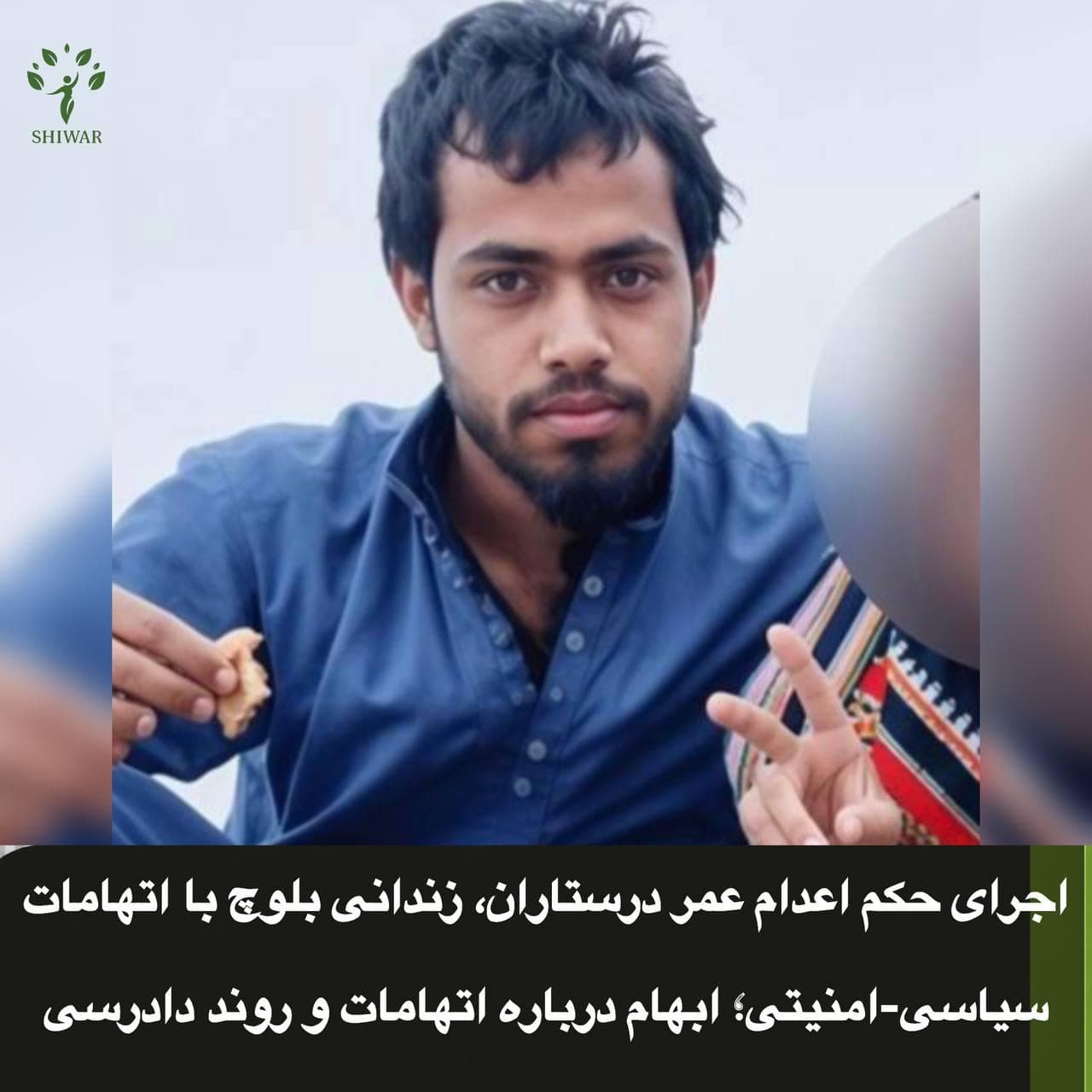
Shiwar News – Monday, 12 October 2026: Iranian state-affiliated media reported the execution of Omar Dorostaran, a Baloch citizen who was arrested by security forces in April 2024.
Iranian authorities alleged that he was a member of Jaish al-Adl and had played a supporting role in several attacks against military and police facilities. However, questions remain regarding the evidence supporting these allegations, the judicial proceedings and his access to fundamental legal rights.
The prisoner was identified as Omar Dorostaran, son of Abdolqader, from Cheraghan village in Rask County. He was 25 years old at the time of his arrest. He had previously studied at a religious school in Rask and was a student of Sunni cleric Molavi Abdolghaffar Naghshbandi. At the time of his arrest, he was continuing his religious studies at a school in Pishin.
According to reports published at the time, Dorostaran was arrested in April 2024 after the evening Isha prayer by plainclothes officers affiliated with the Intelligence Ministry in Rask. The officers reportedly did not present a judicial warrant or explain the reason for his arrest, and he was transferred to an undisclosed location.
Forty days after his arrest, his family and relatives reportedly remained unaware of his whereabouts and condition. Their attempts to obtain information from the relevant authorities had not received a clear response.
When announcing the execution, state-affiliated media cited Iranian officials as alleging that Dorostaran had supported attacks on the police headquarters in Rask, the Islamic Revolutionary Guard Corps facility in the county, the Parud base and military facilities in Chabahar during April 2024.
However, the published reports did not provide specific details of the evidence used to substantiate these allegations or establish his precise role in the attacks.
Despite the announcement of his execution, independently verified information remains unavailable regarding the dates of court hearings, the specific charges in the indictment, the judicial evidence, his access to a lawyer of his choice, his ability to present an effective defence or whether his family was informed before the execution.
These unresolved questions, particularly in light of earlier reports that he was arrested without the presentation of a judicial warrant and that his family remained unaware of his whereabouts for an extended period, raise serious concerns about whether fair trial guarantees were respected throughout the proceedings leading to his death sentence and execution.