From natural fibres and textiles to pharmaceutical research: what potential does a plant studied in many countries have for creating employment in Balochistan?
Shiwar News – Saturday, 24 October 2026
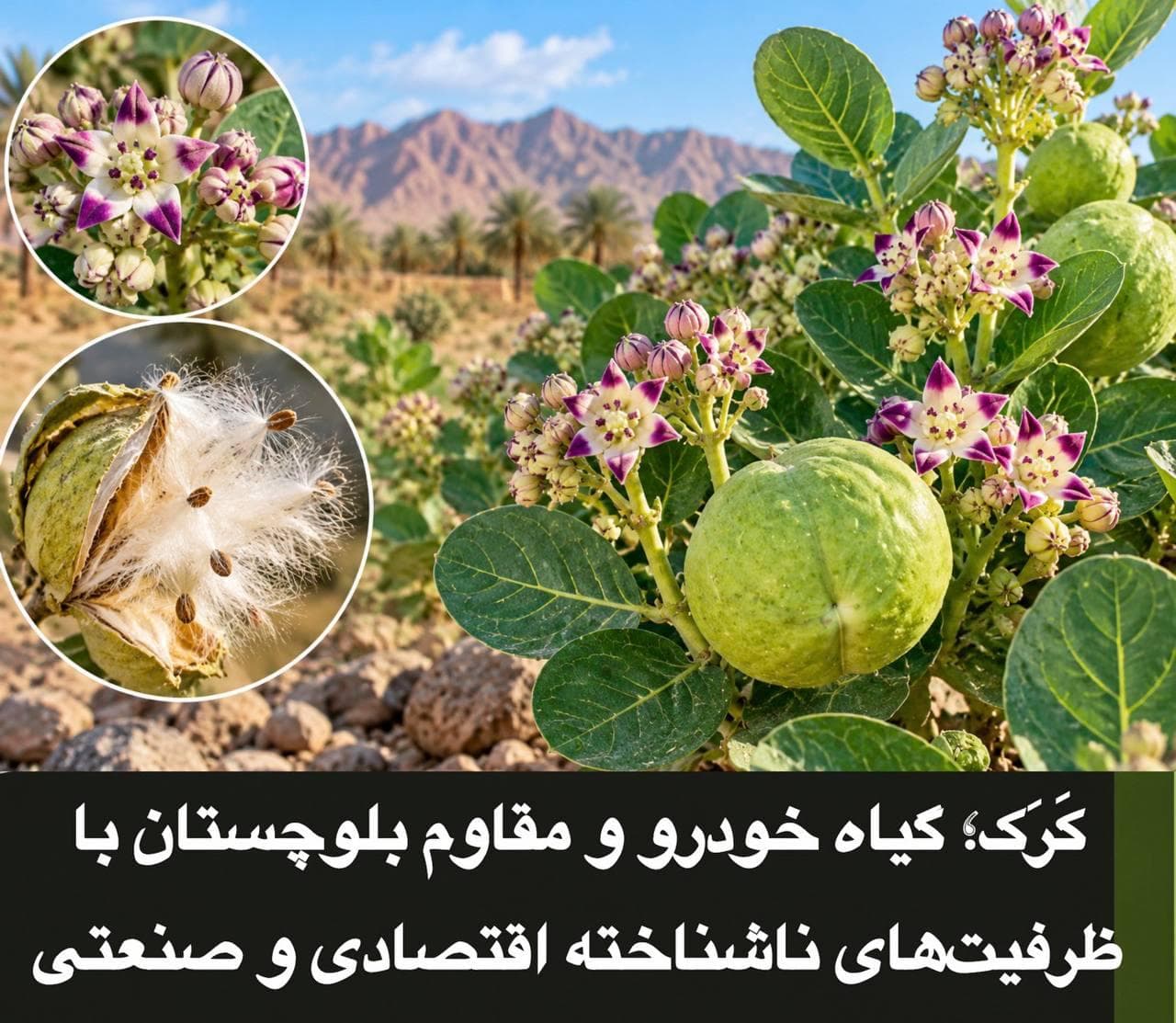
In the hot and arid regions of Balochistan, a plant with broad, thick leaves, white and purple flowers, and swollen green fruits grows naturally. In some areas, it is known as “Kark”. Its scientific name is Calotropis procera, and it is a drought-resistant species found not only in Iran but also in various parts of Asia, Africa and elsewhere in the world.
At first glance, Kark may appear to be just another wild plant growing in dry, water-scarce landscapes. However, scientific studies indicate that different parts of the plant, from the fibres inside its fruits to the bark of its stems, have potential applications in industrial products and handicrafts.
According to information published by the Royal Botanic Gardens, Kew, Calotropis procera is native to extensive areas of Africa and Asia and grows in countries including Iran, Pakistan, India, Afghanistan, Oman, Saudi Arabia, Egypt, Sudan and Kenya.
The plant has also spread to parts of Australia, South America and Central America. Its resistance to drought, high temperatures and difficult soil conditions enables it to survive in arid environments.
However, its spread is not considered beneficial everywhere. In some countries, including Australia, it is classified as an invasive plant because of its extensive growth and distribution.
One of Kark's most distinctive features is its swollen green fruit. When the fruit ripens, its outer covering splits open, releasing seeds attached to white, silky fibres.
These fibres are extremely lightweight and have traditionally been used in some parts of the world to fill pillows and similar products.
Stronger fibres can also be extracted from the plant's stem bark and used to make rope, thread and certain woven products.
One scientific study examined the possibility of producing fabric by blending Kark stem fibres with cotton. The findings suggested that these fibres have mechanical properties that could make them suitable for textile applications, although difficulties with spinning and yarn uniformity remain obstacles to industrial-scale production.
The plant's potential applications extend beyond thread and fabric production.
In a scientific study published in 2025, researchers investigated the ability of Kark fibres to separate mineral oils from water.
The findings indicated that the fibres' distinctive structure enables them to absorb oil, suggesting possible applications in natural filtration systems.
Under laboratory conditions, the fibres absorbed more than 95% of the oil in the tested sample using certain experimental methods.
However, this result does not mean the technology is ready for widespread industrial use. Further research and development are required.
Other studies have also explored the plant's potential for paper production, natural materials, biofuels and environmental applications.
Kark has a history of use in traditional medicine in parts of Asia and Africa. Its chemical compounds have been investigated for possible antimicrobial and anti-inflammatory properties.
However, the plant contains a toxic white latex that can cause skin injuries, poisoning and serious eye damage.
The presence of toxic compounds in different parts of the plant means that using it for self-treatment is dangerous. Any potential medical applications must be investigated through scientific research and under professional supervision.
Balochistan's hot and arid climate provides a natural habitat for this plant.
In a scientific study published in 2026, researchers examined the morphological characteristics of 50 plant samples collected from five areas of Sistan and Balochistan Province, including Rask, Pishin and Bahukalat.
The findings showed considerable variation in the physical characteristics of the samples, particularly their fruits. Such variation could be important for future research into the plant's possible applications.
Given Balochistan's established handicraft traditions and local skills, studying the extraction and processing of Kark fibres could provide a starting point for investigating small-scale economic activities.
For example, researchers could examine whether the fibres could be used to produce decorative items, handicrafts and certain natural materials.
However, before such activities could be introduced, technical studies, safety assessments, market research and production cost evaluations would be necessary.
At present, the evidence reviewed for this report does not indicate that a large, established industry based on Kark processing exists in Balochistan.
Alongside its recognised potential in agriculture, fisheries and handicrafts, Balochistan is home to native and drought-resistant plant species whose economic and environmental applications deserve further investigation.
However, turning a wild plant into a sustainable source of income requires more than identifying its possible uses. It also requires scientific research, processing technologies, investment, workforce training and access to markets.
A fundamental question is how extensively Balochistan's plant resources have been systematically studied and what programmes exist to assess their sustainable economic potential.
Kark is one example of a plant whose various applications have been explored in international research. Yet the extent to which these possibilities could become real economic opportunities in Balochistan remains uncertain and requires specialised and field-based investigation.
Identifying local natural resources and investing in applied research could contribute to economic development and employment opportunities in Balochistan, provided that economic benefits, worker safety and environmental protection are considered together.