Shiwar News
In a province that has long struggled with widespread poverty, unemployment, deprivation and structural discrimination, figures announced by the Imam Khomeini Relief Committee have once again highlighted the troubling situation facing children in Balochistan.
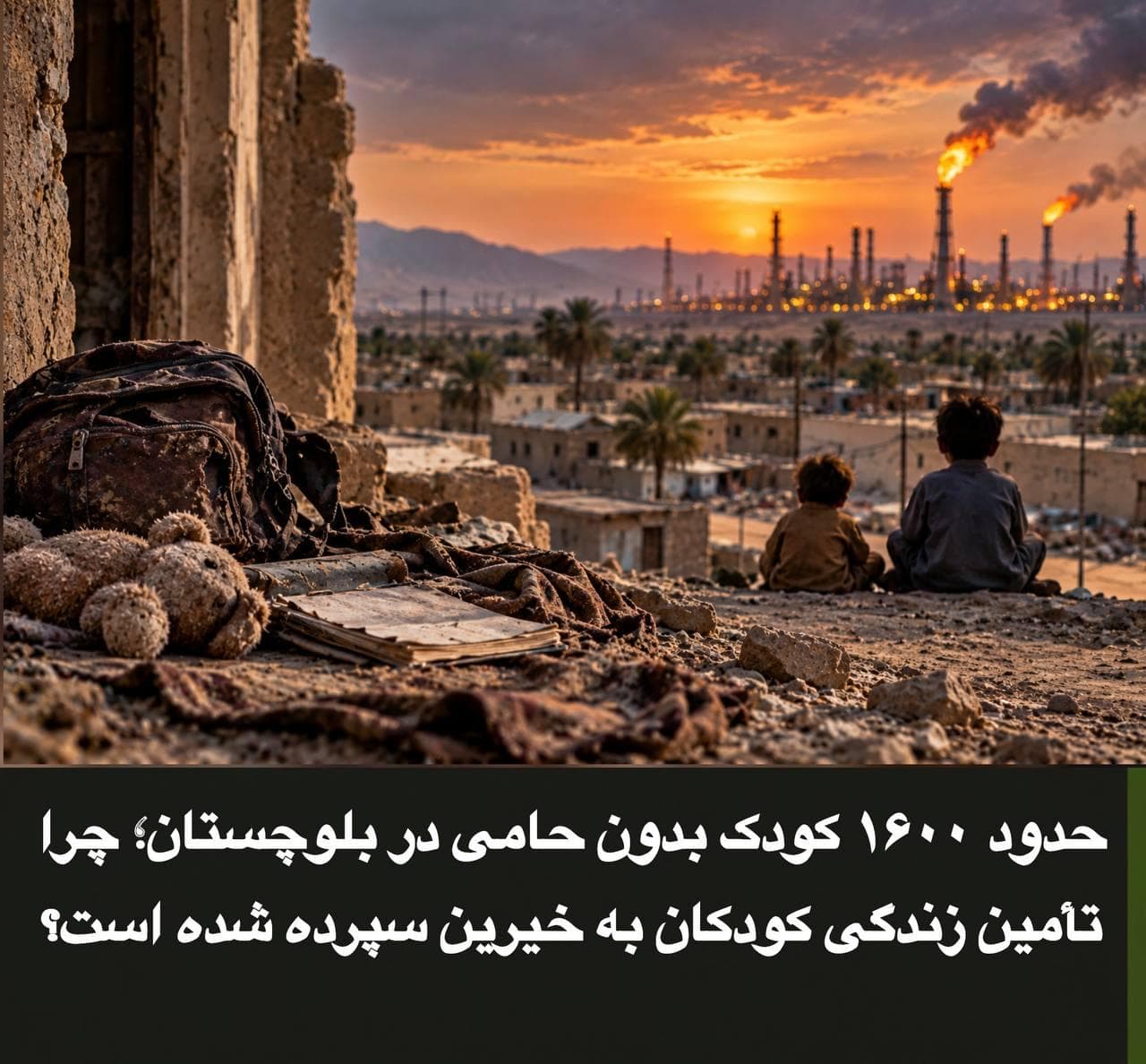
Despite living in a country with vast oil, gas and other national resources, many children remain dependent on charitable contributions to meet their most basic needs.
The head of the Relief Committee in Balochistan has announced that approximately 33,000 sponsors currently provide financial and moral support to children covered by the organisation. However, more than 1,200 orphaned children and 398 children registered under the Mohsenin support programme remain without sponsors.
These figures indicate that at least 1,598 children in need of support do not have individual sponsors under the committee's charitable support schemes.
But a more fundamental question remains: why should meeting children's basic needs in a country with such extensive national resources depend on voluntary charitable contributions?
Why does the government continue to appeal to individuals and charities for assistance instead of presenting a clear programme to ensure these children's livelihoods, education, healthcare and social security?
Is guaranteeing minimum living standards for disadvantaged children not a responsibility of the state?
Child poverty in Balochistan is not an isolated or accidental phenomenon. It reflects years of ineffective policymaking, structural deprivation and the government's failure to ensure social justice.
Many families in Balochistan face severe economic hardship. Widespread unemployment, a lack of sustainable job opportunities, inadequate educational and healthcare infrastructure, and rising living costs have significantly weakened families' ability to support their children.
Under these circumstances, orphaned children and children whose parents or guardians are unable to provide for them face an increased risk of deprivation, dropping out of school, child labour and other social harms.
Further questions must also be asked about the circumstances in which these children currently live.
Which institutions monitor their nutrition, health, education and safety? Is government assistance sufficient to meet their essential needs? How do children without sponsors cover their living and educational expenses?
Another concerning point is that the Relief Committee's figures reflect only those individuals who have been identified and registered in its support programmes.
Therefore, these figures do not necessarily provide a complete picture of the number of orphaned, disadvantaged or inadequately supported children across Balochistan.
The actual number of children requiring assistance may be higher than the official figures, highlighting the need for comprehensive and transparent information.
The issue is not simply the 1,598 children without sponsors. It is a structural problem in which the wellbeing of disadvantaged children has become tied to voluntary donations.
Charitable assistance is valuable and humane, but no charity should replace the legal and social responsibilities of the state.
Supporting children is not an act of generosity by the government. It is a fundamental right that must be guaranteed without discrimination or dependence on the financial capacity of charitable donors.
In a province where a large proportion of the population faces multiple forms of deprivation, the publication of these figures should serve as a serious warning to officials rather than merely another opportunity to appeal for public donations.
The question remains: where is the country's national wealth being spent when thousands of children in Balochistan are still waiting for charitable support to secure basic living conditions?
A government that controls the country's resources must explain why, after decades, it has still failed to create conditions in which no child is deprived of fundamental rights because of poverty, orphanhood or their family's economic circumstances.